Doors, windows and glass · Western PR · In production, daily use
Alutek
A healthy business running on notebooks, WhatsApp and the owner's memory. Today it runs on a system that holds it on its own.
Case video
The business
Alutek installs doors, windows and railing glass in western Puerto Rico. Between five and twelve people: field installers, warehouse, assembly and design, and the office. Five to ten quotes a week, almost all of them close. Seven to ten active jobs at a time. Two or three people walking through the door every day asking for a price.
The business was healthy. The chaos was operational.
How it was breaking
That distinction is the whole project. Nobody called Nerigma because sales were bad. They called because the owner was the bottleneck of his own business: prices lived in his head, payments came in without being recorded, the schedule existed but nobody respected it, and the only way to know where a job stood was asking someone.
Before Nerigma, Alutek had turned down two vendors selling them software. They chose us because instead of a demo, the first thing that happened was an evaluation visit in the shop: photos, real quotes, real work orders, and hours of conversation about how the work actually gets done.
What was built
The complete commercial chain
Customer → estimate → invoice → work order → calendar → payment. The company's entire history came in: 253 real customers and 427 historical invoices migrated from the previous system, without losing or inventing a single record. Those that didn't match were kept with their original text, intact, to reconcile with the owner instead of guessing.
The shop and the street
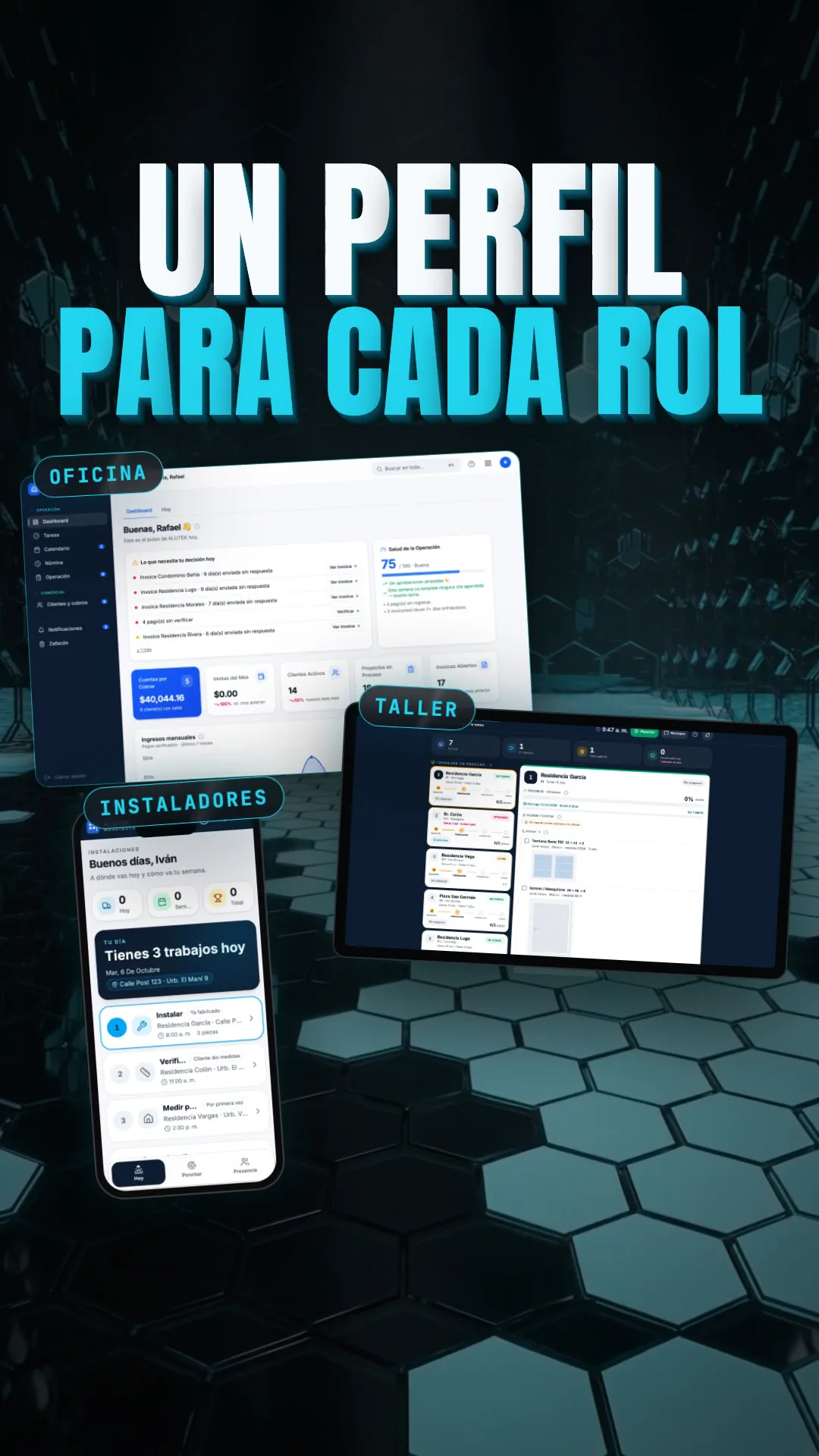
Work flows from the office down to the shop floor and from there to the installer in the field. The installer reports from their phone what actually happened; nobody asks them to update a status in a menu.
Time clock and hours
The shop's attendance control, with the company's real rules: shifts, lunch, caps and the handling of the odd cases that don't show up on paper but do in real life.
Roles with real guardrails
The lead assistant sees money, but her sensitive actions go through the owner's approval. Another assistant sees quote prices but not the overall finances. The owner's father helps with quotes and sees no money on any screen, on any route. Every new screen declares who can see it the moment it's created.
An AI assistant
Inside the system, reading documents and answering questions about the operation.
A COO module
That doesn't just display data: it reviews the state of the operation and proposes concrete actions — this has been stalled for days, this contradicts that, this needs to be collected.
An automation boundary the system never crosses
Pricing, collections, payroll, time punches, moving an already-committed job, and anything the end customer sees: a person decides that. Always. The software pushes; it doesn't force.
The purpose
Get the owner out of being the bottleneck of his own business.
Everything else — the screens, the roles, the agent, the COO module — exists for that. An owner who carries the operation in his head can't take vacations, can't delegate and can't grow, because the business's limit is his memory and his hours.
What it's for
A definition of done that can be verified, not argued:
A job enters as an estimate in the field and reaches collected without anyone having to tell the system what state it's in — just by reporting what actually happened.
That sentence governs every design decision. The system doesn't ask "what stage is this at?". It records facts — it was quoted, the deposit came in, it was fabricated, it was installed, it was collected — and derives the state from those facts. Nobody maintains a status by hand, because a status maintained by hand is a status that drifts.
The long-term goal
On-site COO → digital COO.
Phase one: someone steps into the operation in person and holds it. Visits, adjustments, sitting next to the people who will use it. Phase two: the system holds it on its own, and that person is no longer needed every day.
That's the full arc, and it's why this project is 30% code and 70% adoption. Building the system is the easy part. Getting the shop to use it on any given Tuesday at 7 a.m., with dirty hands and the phone in a pocket, is the real work.
At a glance
- Sector
- Doors, windows and glass · Western PR
- Size
- 5–12 people
- What it is
- The company's complete operating system
- Modules
- Commercial · Shop · Field · Time clock · Roles & permissions · AI assistant · COO module
- Data migrated
- 253 customers · 427 historical invoices
- Stack
- Next.js · Prisma · Supabase · Vercel
- Status
- In production, daily use